
Deltaran — the precedent
A real, registered, peer-reviewed-documented drug that combined DSIP with glycine in 1998 — a quarter-century before this site existed, and absent from every English-language peptide-vendor page this research pass could find.
What Deltaran is
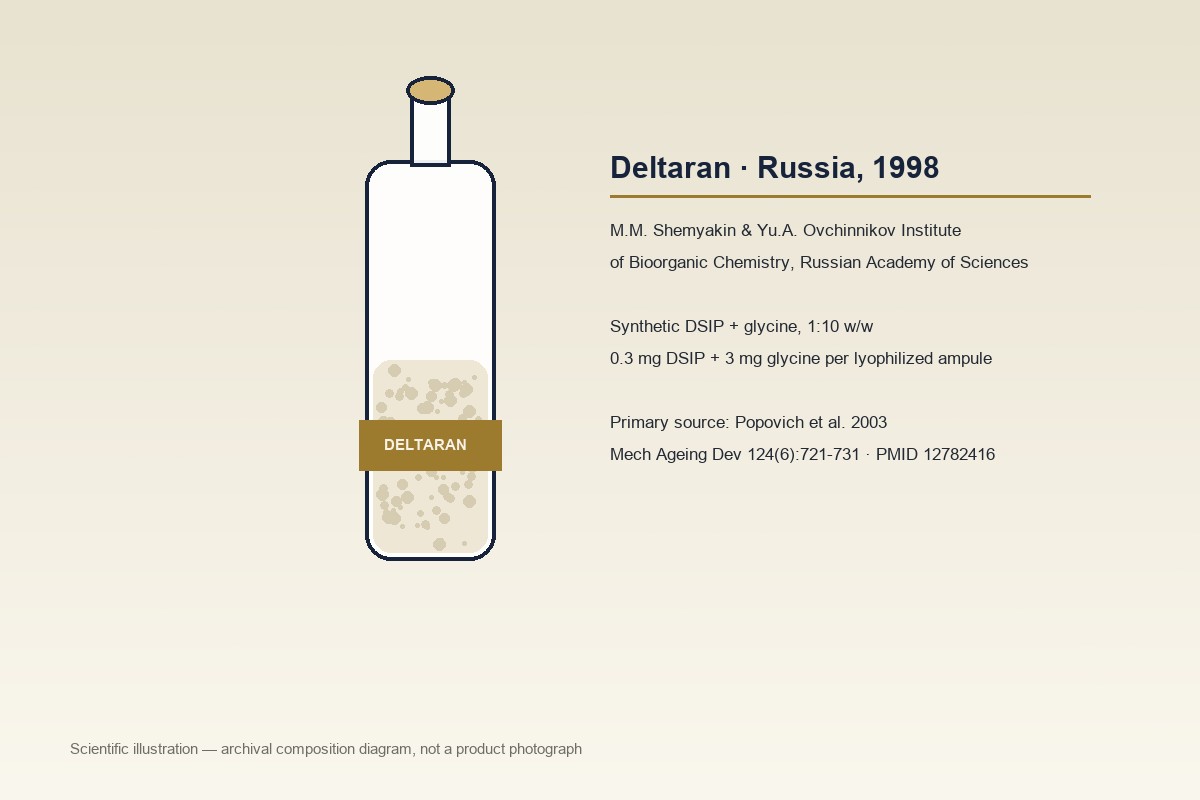
Deltaran was developed and registered in Russia in 1998 at the M.M. Shemyakin and Yu.A. Ovchinnikov Institute of Bioorganic Chemistry, part of the Russian Academy of Sciences. It ships as a lyophilized ampule — a freeze-dried powder for reconstitution — containing synthetic DSIP and glycine at a fixed mass ratio.
We obtained and read, in full, the peer-reviewed paper that states this composition exactly: Primary source Popovich et al., 2003, Mechanisms of Ageing and Development 124(6):721-731 (PMID 12782416):
"Deltaran® is a mixture of synthetic DSIP (Trp-Ala-Gly-Gly-Asp-Ala-Ser-Gly-Glu) and glycine (w/w as 1:10) ... Each glass contains 0.3 mg of DSIP and 3 mg glycine."
A secondary Ukrainian medical-news source (mif-ua.com) describes Deltaran but does not state the glycine ratio at all; a Russian-language critique wiki (sportwiki.to) does state the 1:10 ratio. The primary, peer-reviewed paper above adjudicates this in sportwiki's favor — a reminder that even within non-Western sources, aggregator quality varies and primary literature is the tie-breaker, not blanket trust or blanket suspicion of any one source class.
The animal evidence
Animal evidence Popovich et al. (2003) dosed 54 SHR-strain mice per group subcutaneously across their lifespan and reported increased maximum and late-life lifespan and reduced spontaneous tumor incidence versus control. This is a real, peer-reviewed, PubMed-indexed result — and, as far as this research pass could establish, it has never been independently replicated outside the original St. Petersburg/Moscow-affiliated research network.
Animal evidence A separate line of work by Koplik et al. (P.K. Anokhin Research Institute of Normal Physiology, Moscow) examined Deltaran and DSIP in rats (English translation, 2008, PMID 18975104; Russian original, 2007, PMID 18427460). The abstracts — re-fetched directly via NCBI on 2026-09-10 after a cookie-wall blocked the original research pass — state the species plainly: rats. The studies report that Deltaran increased an index of brain blood supply, and that all Deltaran-treated rats survived experimental cerebral ischemia while death occurred in 38% of untreated animals.
The skeptical case, stated plainly
The patent literature, now directly read
Patent literature WO2007030035A1 ("Agent for correcting stress-inducing neuro-mediator, neuro-endocrine and metabolic disturbances...") — which returned HTTP 503 twice in the original research pass — was fetched and read in full on 2026-09-10. The widely quoted DSIP-to-glycine mass-ratio range of 1:1 to 1:100 does appear in that document, but in its prior-art discussion: it is attributed to a Russian Federation patent covering a DSIP-plus-glycine anti-stress medicine (the Deltaran family), not advanced as this patent's own ratio. Deltaran's marketed 1:10 ratio sits inside that claimed range — ordinary patent-claim breadth, not a contradiction. Separately, WO2007030035A1's own claims do name glycine: its compositions may include synergistically acting amino acids such as the inhibitory neurotransmitter glycine, and one claim covers adding glycine or trimethylglycine to enhance therapeutic effect.
The open formulation question: why glycine, at that ratio?
No primary source located in this research pass states why glycine was chosen, or why at a 1:10 ratio. Three explanations are equally plausible on the available evidence, and none should be presented as the designer's confirmed intent:
(a) Glycine's own sleep/thermoregulatory action. Glycine has its own, separately documented NMDA-receptor sleep mechanism (see the glycine page) — mechanistically distinct from DSIP, and plausibly additive or non-interfering rather than antagonistic.
(b) A lyophilization formulation role. Glycine is a common pharmaceutical bulking agent in freeze-dried preparations. It typically crystallizes during lyophilization, providing cake structure rather than protein stabilization — amorphous (non-crystallizing) glycine is the exception that actually stabilizes a co-formulated protein. Panacea's own TgShift™ terminology work independently classifies glycine among the crystalline, eutectic-forming excipients, consistent with this reading. At 3 mg per ampule — well within glycine's normal dietary range — a purely trace excipient role is not the only plausible reading either.
(c) Coincidental to DSIP's own sequence. DSIP's own nonapeptide sequence already contains three glycine residues. That is a structural curiosity about the peptide itself, not a causal explanation for why free glycine was added to the formulation, and this page does not imply otherwise.
Panacea's honest position
Panacea Bio Chem makes no claim to have replicated, improved on, or been affiliated with Deltaran — no evidence located in this research pass supports such a claim, and none is implied anywhere on this site. What is genuinely notable, and original to this research, is that Deltaran's lyophilized-ampule presentation sits in exactly the format class Panacea's own Lyoprester® dual-chamber cartridge architecture and TgShift™ process work address — a formulation-science observation, not a product claim.
Return to the home page evidence atlas, or read the DSIP page and the glycine page for the two ingredients on their own terms.