DSIP mixed with glycine: what fifty years of research — and a 1998 Russian drug — actually show
Delta sleep-inducing peptide (DSIP) is a nonapeptide first drawn from rabbit blood in 1977, and its human results have divided its own discoverers ever since. Glycine is the everyday amino acid with a newer, sturdier human sleep-trial record. Combining them is not a new idea: Deltaran, a lyophilized DSIP-plus-glycine preparation, was registered in Russia in 1998. This page tells all three stories with their evidence tiers kept visibly apart.
01What DSIP and glycine are
Two very different molecules meet on this page: a rarely-used, disputed research peptide, and one of the most common molecules in the human body.
DSIP — delta sleep-inducing peptide
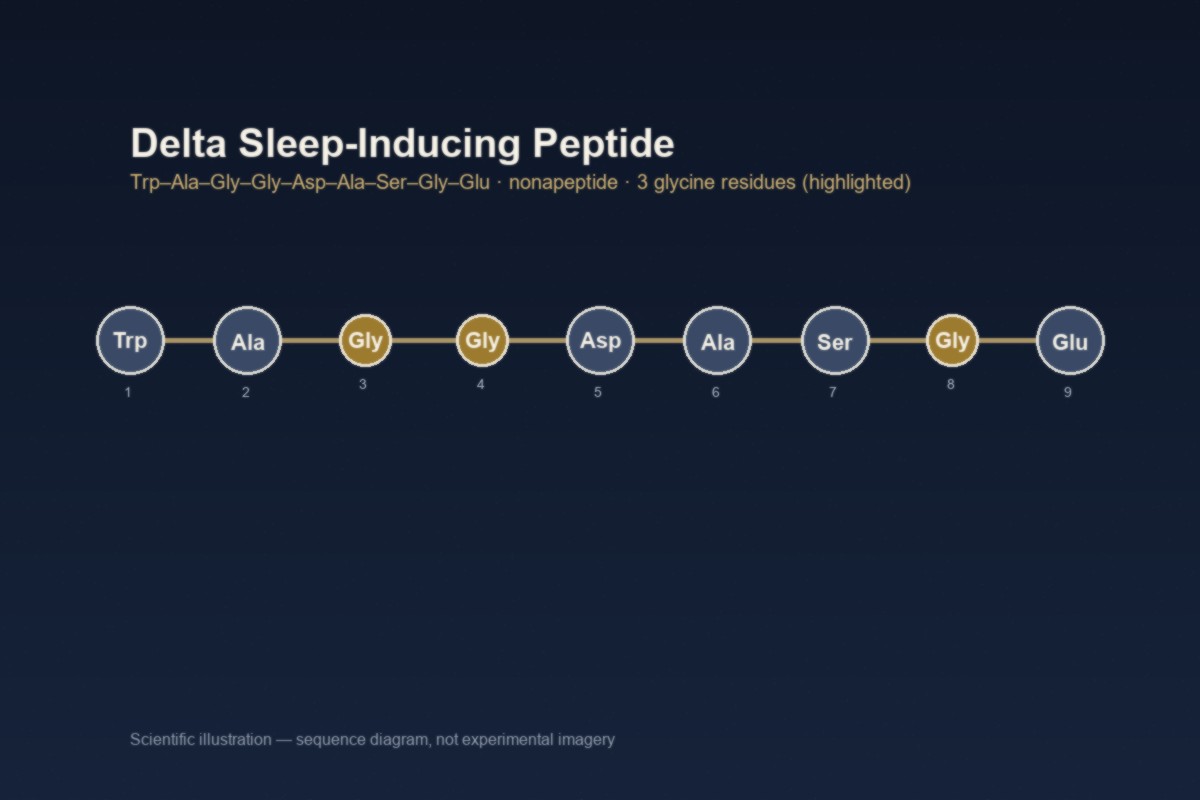
A nonapeptide, Trp-Ala-Gly-Gly-Asp-Ala-Ser-Gly-Glu, isolated in 1977 from rabbit cerebral venous blood drawn during electrically induced sleep (reviewed by Graf & Kastin, 1984, PMID 6145137). Its own sequence happens to contain three glycine residues — a structural curiosity, not evidence of any designed link to co-administered glycine.
Glycine — the simplest amino acid
A proteinogenic amino acid and inhibitory neurotransmitter, and — separately — an NMDA-receptor co-agonist implicated in sleep and thermoregulation via the suprachiasmatic nucleus (Kawai et al., 2015, PMID 25533534). It is also a common pharmaceutical lyophilization bulking agent — a formulation role explored further on the Deltaran page.
Is DSIP endogenous?
Debated, not settled. Animal (rat) immunohistochemical studies localize DSIP-like immunoreactive material to brain regions (Skagerberg et al., 1991 (PMID 1800953), cited in Popovich et al. 2003, PMID 12782416). On the human side, primary assays do exist: Graf, Kastin and Fischman (1984, PMID 6549071) reported DSIP-like immunoreactivity in human plasma, CSF and urine, and Graf, Hunter and Kastin (1984, PMID 6547144) reported it in human milk — antibody-recognition signals whose relationship to the authentic free peptide remains unsettled (see the DSIP page).
Does DSIP have a known receptor?
No specific DSIP receptor has been conclusively identified after nearly fifty years of study — a fact any honest DSIP page states plainly rather than skipping past. See the DSIP page for the full history and the genuine dispute over whether it works at all.
02How this page grades evidence
DSIP folklore is thick in peptide-community spaces. Every claim on this site is tagged with the tier of evidence behind it, and the tiers are never blended together as if they carried equal weight.
Mechanistic In vitro Animal Observational human Interventional human Unproven hypothesis
03Evidence atlas
| Claim | Tier | Source |
|---|---|---|
| DSIP improved sleep efficiency and shortened sleep latency vs placebo in chronic insomniacs (double-blind) | Interventional human | Bes et al., 1992, Neuropsychobiology — PMID 1299794 |
| DSIP is degraded rapidly by plasma enzymes (minutes-to-under-an-hour range) | Mechanistic | Graf, Saegesser & Schoenenberger, 1987 — PMID 3628078 |
| DSIP reduced pronounced chronic pain episodes in a clinical pilot (separate from sleep) | Interventional human | Larbig et al., 1984 — PMID 6548970 |
| 3 g oral glycine before bed improved subjective sleep quality/next-day performance (randomized, double-blind, crossover) | Interventional human | Bannai & Kawai, 2012 — PMID 22529837 |
| Glycine's sleep-promoting/hypothermic action is mediated by NMDA receptors in the suprachiasmatic nucleus | Mechanistic | Kawai et al., 2015 — PMID 25533534 |
| Oral glycine raised extracellular serotonin (not dopamine) in rat prefrontal cortex | Animal | Bannai et al., 2011 — PMID 21414089 |
| Deltaran (DSIP + glycine, 1:10 w/w) increased late-life lifespan and reduced spontaneous tumor incidence in SHR mice | Animal | Popovich et al., 2003 — PMID 12782416 |
| Deltaran increased a brain blood-supply index in rats; all Deltaran-treated rats survived experimental cerebral ischemia (38% deaths in untreated animals) | Animal (rats) | Koplik et al., 2008 — PMID 18975104 |
| Glycine's role in Deltaran's ratio was chosen specifically for a sleep-synergy effect with DSIP | Unproven hypothesis | Not stated by any primary source located — see the Deltaran page for the three competing explanations |
| A DSIP+glycine combination is registered or studied in a modern human clinical trial | Unproven hypothesis | No qualifying ClinicalTrials.gov entry found (searched 2026-09-05) — see §5 below |
04Deltaran — the precedent nobody in English-language peptide circles mentions
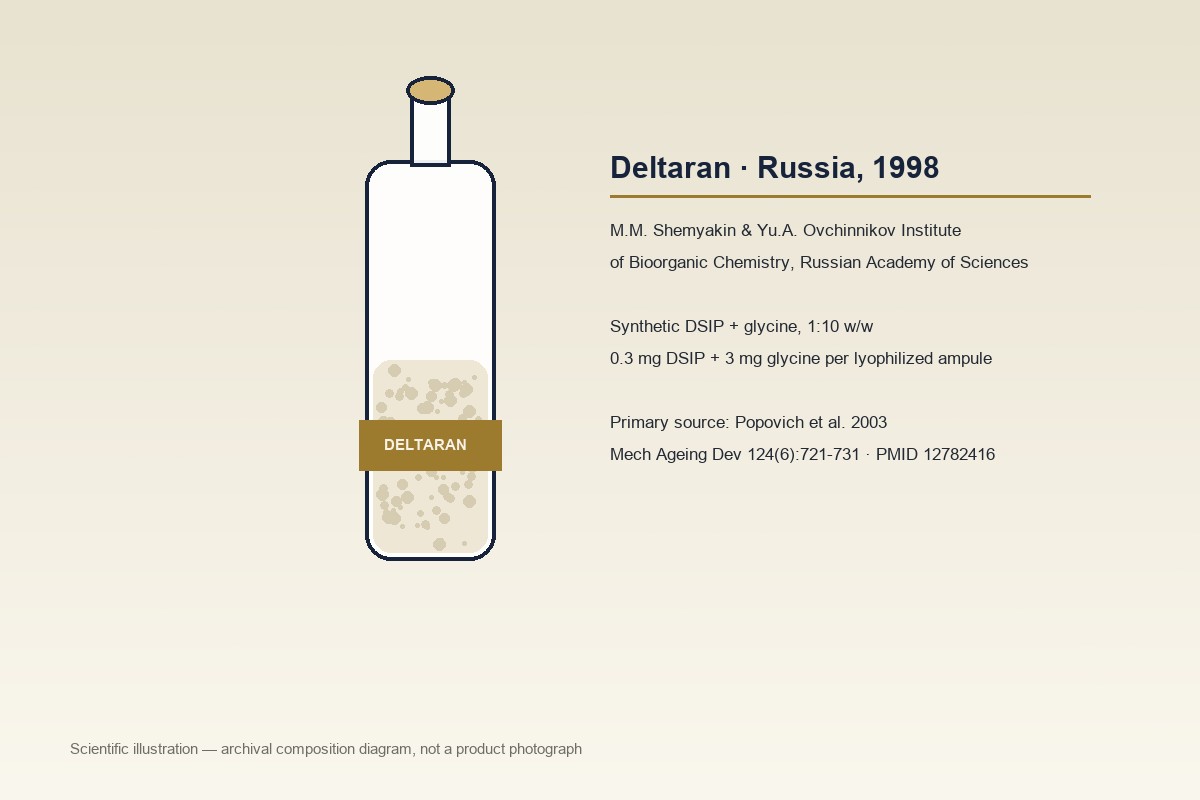
In 1998, researchers at the M.M. Shemyakin and Yu.A. Ovchinnikov Institute of Bioorganic Chemistry (Russian Academy of Sciences) registered Deltaran: a lyophilized ampule containing synthetic DSIP and glycine at a fixed 1:10 mass ratio — 0.3 mg DSIP and 3 mg glycine. The exact composition is confirmed, word for word, in a peer-reviewed paper we read in full: "Deltaran® is a mixture of synthetic DSIP ... and glycine (w/w as 1:10) ... Each glass contains 0.3 mg of DSIP and 3 mg glycine" (Popovich et al., 2003).
We searched the English-language peptide-vendor space this pass and found dozens of pages discussing DSIP alone, and several already proposing an informal "DSIP + glycine" community stack — but not one that names Deltaran. That gap, not any claim about Panacea's own formulation, is the genuine finding here.
Full history, the mouse-study data, and the skeptic's dose critique → Read the Deltaran page ↗05Regulatory status, dated (2026-09-05)
Two separate, verifiable facts — kept separate because they answer different questions.
FDA compounding review, July 2026
On 2026-07-23/24, the FDA's Pharmacy Compounding Advisory Committee reviewed DSIP — under the regulatory working name "Emideltide" — for inclusion on the 503A bulk drug substances list, alongside six other peptides. The committee voted 7-6 (one abstention) against recommending DSIP; it was the only "no" among the seven peptides reviewed that meeting (BPC-157, KPV, TB-500, MOTS-c, epitalon and semax received a "yes" vote for inclusion). Cited concerns: inconsistent naming, poor characterization of the substance, low-quality efficacy evidence, and existing approved therapies for the proposed uses. This finding is confirmed by nine independent trade and legal-industry outlets converging on the same vote count and date; the underlying FDA meeting document itself could not be machine-read this pass, so it is reported here as a secondary, cross-verified report rather than a primary-document citation.
Registered clinical trials: an absence, stated honestly
Searched ClinicalTrials.gov (API v2) on 2026-09-05 with the terms "delta-sleep-inducing peptide" (0 studies), DSIP insomnia (0 studies), and emideltide (0 studies). A search for glycine insomnia returned 10 studies, none matching glycine-as-a-sleep-intervention. Not searched this pass: WHO ICTRP, the EU CTR/CTIS, Japan's jRCT/UMIN registries (relevant because the strongest glycine sleep trial is Japanese), and Russian trial registries (relevant because Deltaran predates modern registry norms). This is a dated, scoped absence — not a claim that no such trial has ever existed anywhere.
06The honest skeptical questions
If DSIP works, why did fifty years of research never produce an approved drug? Bes et al. (1992) reported a real, positive double-blind result in chronic insomniacs — but later reviewers describe it as difficult to reproduce at scale. Neurophysiologist Alexander Borbély publicly called DSIP "a flop as a sleep substance"; Karl Schoenenberger, DSIP's own co-discoverer, disagreed. That is a genuine, citable scientific dispute between two named scientists — not a manufactured controversy, and this site does not resolve it artificially in either direction.
Was Deltaran's animal result ever independently replicated? Not in the literature located this pass. The lifespan/tumor-incidence result (Popovich et al., 2003) comes from a single research network (St. Petersburg/Moscow-affiliated institutes). A Russian-language critique source (sportwiki.to) separately argues that Deltaran's clinically marketed intranasal dose sits far below the dose shown active in the mouse studies — calling it, in its own words, "essentially a disguised homeopathic remedy." That is a legitimate dose-translation critique and this page states it rather than omitting it.
07Panacea's angle: the format, not the molecule
Panacea Bio Chem makes no claim to have improved on, replicated, or been affiliated with Deltaran — no evidence supports any such claim, and none is implied. What is genuinely notable is the format: Deltaran ships as a lyophilized ampule of powder, reconstituted before use — exactly the presentation class Panacea's own preservation technologies address.
Lyophilization, honestly framed
Whether glycine in Deltaran acts as a co-active sleep ingredient, a lyophilization bulking agent, or simply rides along with DSIP's own three glycine residues is not established in the literature we located — all three remain open, labeled possibilities. Pharmaceutical glycine typically crystallizes during freeze-drying, giving cake structure rather than protein stabilization; amorphous glycine is the exception that stabilizes a co-formulated protein. Panacea's own TgShift™ terminology work independently classifies glycine among the crystalline, eutectic-forming excipients — consistent with the "usually crystallizes" reading.
The dual-chamber answer to an old formulation problem
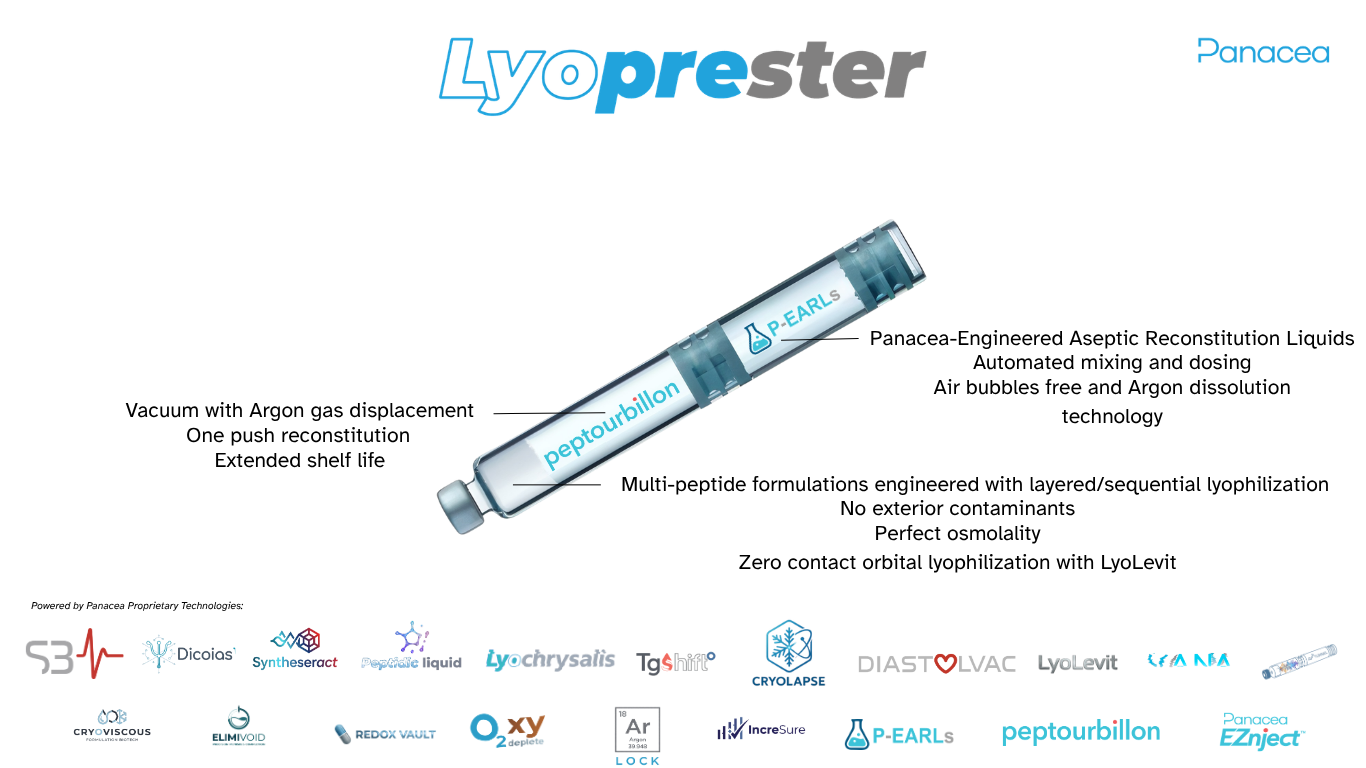
A lyophilized peptide ampule that must be reconstituted by hand, at the bedside, is exactly the step Panacea's Lyoprester® dual-chamber cartridge architecture was built to remove — the diluent held apart from the dried cake until the moment of use, under an inert atmosphere.
Panacea Bio Chem is positioned, on its own word and its own engineering record, as a leading peptide formulation and preservation house — built on the dual-chamber cartridge, argon-fillback sealing, and lyophilization process work described across the estate.

"DSIP has spent fifty years being either overpromised or dismissed. Neither is honest. The molecule Deltaran actually paired it with — glycine — has since built a far sturdier case for itself in its own right. We'd rather show both stories straight than pretend the peptide is the whole answer."
by Bogdan Dicoias, biochemist and inventor — Panacea Bio Chem Ltd
08Frequently asked questions
What is DSIP?
A nonapeptide isolated in 1977 from rabbit blood during electrically induced sleep. Human trial results are genuinely disputed. Full history on the DSIP page.
Is DSIP + glycine a Panacea invention?
No. Deltaran, a real DSIP+glycine drug, was registered in Russia in 1998 — decades before this site existed. Panacea did not invent the combination; this page documents it.
Does glycine alone help sleep?
Its human evidence is more recent and more robust than DSIP's own. See the glycine page for the trial data and mechanism.
Is DSIP available or legal to buy in the US?
It is not FDA-approved as a drug, and in July 2026 an FDA advisory committee voted against adding it to the 503A compounding list. See §5 above for the dated details.
09Trending in the field
Recent developments in the field — refreshed 2026-09-07 by Panacea Bio Chem.
- Therapeutic Peptides in Orthopaedics: Applications, Challenges, and Future Directions — PubMed, 2026 Jan 1
- Domain-specific information preservation for Alzheimer's disease diagnosis with incomplete multi-modality neuroimages — PubMed, 2025 Apr
- Pichia pastoris secreted peptides crossing the blood-brain barrier and DSIP fusion peptide efficacy in PCPA-induced insomnia mouse models — PubMed, 2024
- Sensing the Bactericidal and Bacteriostatic Antimicrobial Mode of Action Using Raman Deuterium Stable Isotope Probing (DSIP) in Escherichia coli — PubMed, 2024 Jun 4
Authorship & trust: concept and direction — Bogdan Dicoias. Published by Panacea Bio Chem Scientific Communications. Status: research/educational summary, not a clinical guideline. Last evidence search: 2026-09-05 (PubMed/NCBI, ClinicalTrials.gov API v2, English- and Russian-language sources). Every citation above links its original source.