
DSIP — delta sleep-inducing peptide
A rarely-discussed research peptide with a genuinely contested fifty-year history. This page separates what was measured from what was claimed.
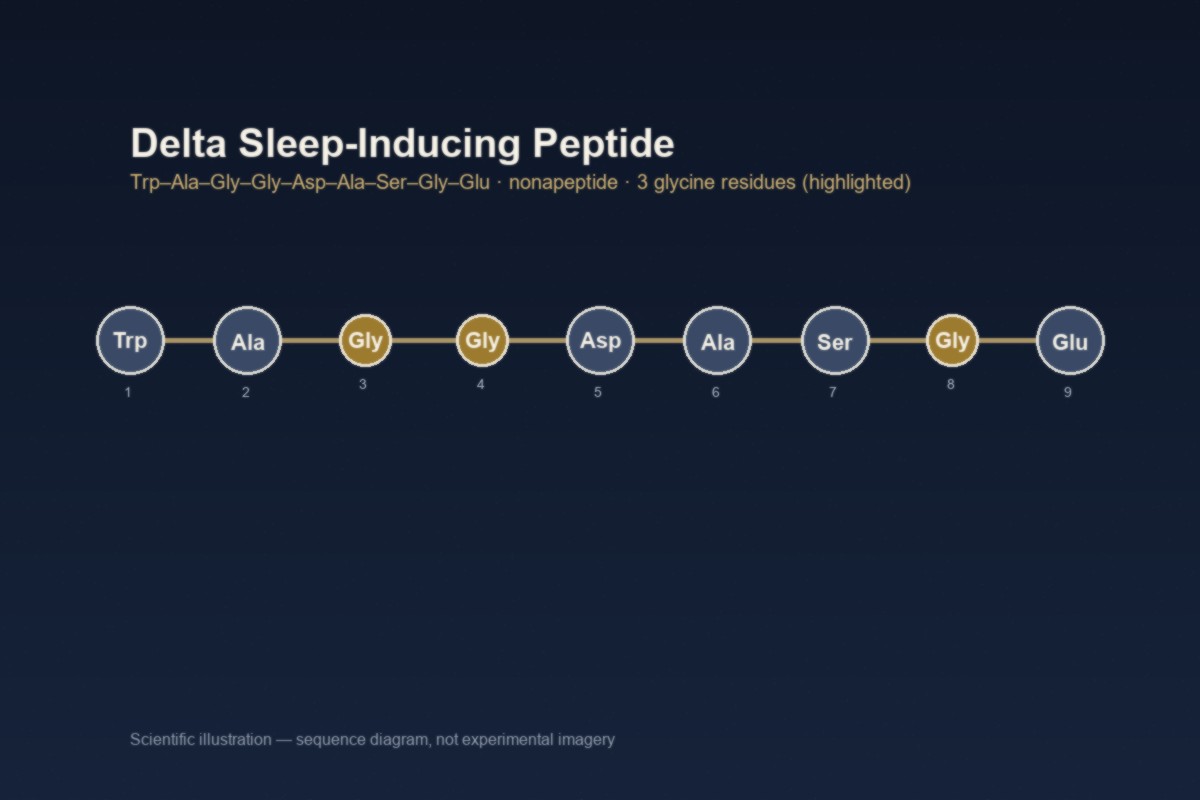
Discovery and sequence
DSIP was isolated in 1977 by Karl Schoenenberger and Marcel Monnier from rabbit cerebral venous blood, drawn during electrically induced sleep — one of the earliest attempts to isolate a specific "sleep substance" from blood. The peptide is the nonapeptide Trp-Ala-Gly-Gly-Asp-Ala-Ser-Gly-Glu, containing three glycine residues as part of its own backbone — a structural fact worth stating precisely and never conflated with glycine as a separately co-administered ingredient (see the Deltaran page for that distinct question). This history is summarized in Graf and Kastin's 1984 review, Review PMID 6145137.
The human trial record — and the dispute
The strongest positive human result located in this research pass is a 1992 double-blind study: Interventional human Bes et al. reported higher sleep efficiency and shorter sleep latency versus placebo in chronic insomniac patients (PMID 1299794). DSIP has also been trialed for a separate indication — chronic, pronounced pain episodes — in a clinical pilot study by Larbig et al., 1984 Interventional human (PMID 6548970), evidence that DSIP has been dosed clinically in humans before, not evidence for sleep specifically.
Despite this, DSIP never became an approved sleep drug. Neurophysiologist Alexander Borbély publicly described DSIP as "a flop as a sleep substance," a position Karl Schoenenberger — DSIP's own co-discoverer — publicly disagreed with. This is a real, named, citable scientific disagreement, and this page states both sides rather than resolving it artificially. After nearly fifty years, no specific DSIP receptor has been conclusively identified, which is itself part of why the debate has never fully settled.
Pharmacokinetics
Mechanistic DSIP is degraded rapidly by plasma enzymes — a stability study by Graf, Saegesser and Schoenenberger (1987) puts its functional plasma survival in the range of minutes to under an hour (PMID 3628078). A short plasma half-life is a genuine pharmacological constraint on any oral or systemic DSIP use, independent of the sleep-efficacy debate above.
Is DSIP endogenous?
Animal Immunoreactive DSIP-like material has been localized to rat brain regions by immunohistochemistry (Skagerberg et al., 1991 (PMID 1800953), cited within Popovich et al., 2003, PMID 12782416). The human side of the claim, left as an open verification gap in the original research pass, does trace to primary literature (verified via NCBI on 2026-09-10): Graf, Kastin and Fischman (1984, PMID 6549071, Pharmacology, Biochemistry, and Behavior) reported DSIP-like immunoreactivity co-eluting with synthetic DSIP in human plasma, free DSIP in human CSF, and DSIP-like material in human urine; and Graf, Hunter and Kastin (1984, PMID 6547144, Journal of Clinical Endocrinology and Metabolism) reported DSIP-like material in human milk. Both papers measure antibody-recognized DSIP-like immunoreactivity — the authors themselves note that only part of the total immunoreactivity matches the free nonapeptide — so the honest statement stands, now with citations attached: DSIP-like immunoreactive material is reported in human plasma, CSF, urine and milk; what that material is, physiologically, remains unsettled.
Regulatory status, dated 2026-09-05
On 2026-07-23/24, the FDA's Pharmacy Compounding Advisory Committee reviewed DSIP — under the working regulatory name Emideltide — for the 503A bulk drug substances list, and voted 7-6 (one abstention) against recommending it; it was the only "no" among seven peptides reviewed that meeting. Cited concerns: inconsistent naming standards, poor characterization, low-quality efficacy evidence, and existing approved therapies for the proposed uses (insomnia, narcotic dependence, opioid withdrawal). This is confirmed by nine independent trade and legal-industry outlets converging on the same vote and date; the underlying FDA document itself could not be machine-read this pass, so this is reported as a cross-verified secondary report, not a primary-document citation.
Absence, dated Searched ClinicalTrials.gov (API v2) on 2026-09-05: "delta-sleep-inducing peptide" (0 studies), DSIP insomnia (0 studies), emideltide (0 studies). Not searched this pass: WHO ICTRP, EU CTR/CTIS, Japan's jRCT/UMIN, and Russian trial registries — each plausibly relevant and each left as an open item rather than folded into a blanket "no trials exist anywhere" claim.
See the home page evidence atlas for DSIP, glycine and Deltaran claims side by side, or read the Deltaran page for the historical DSIP+glycine precedent this site was built to surface.